
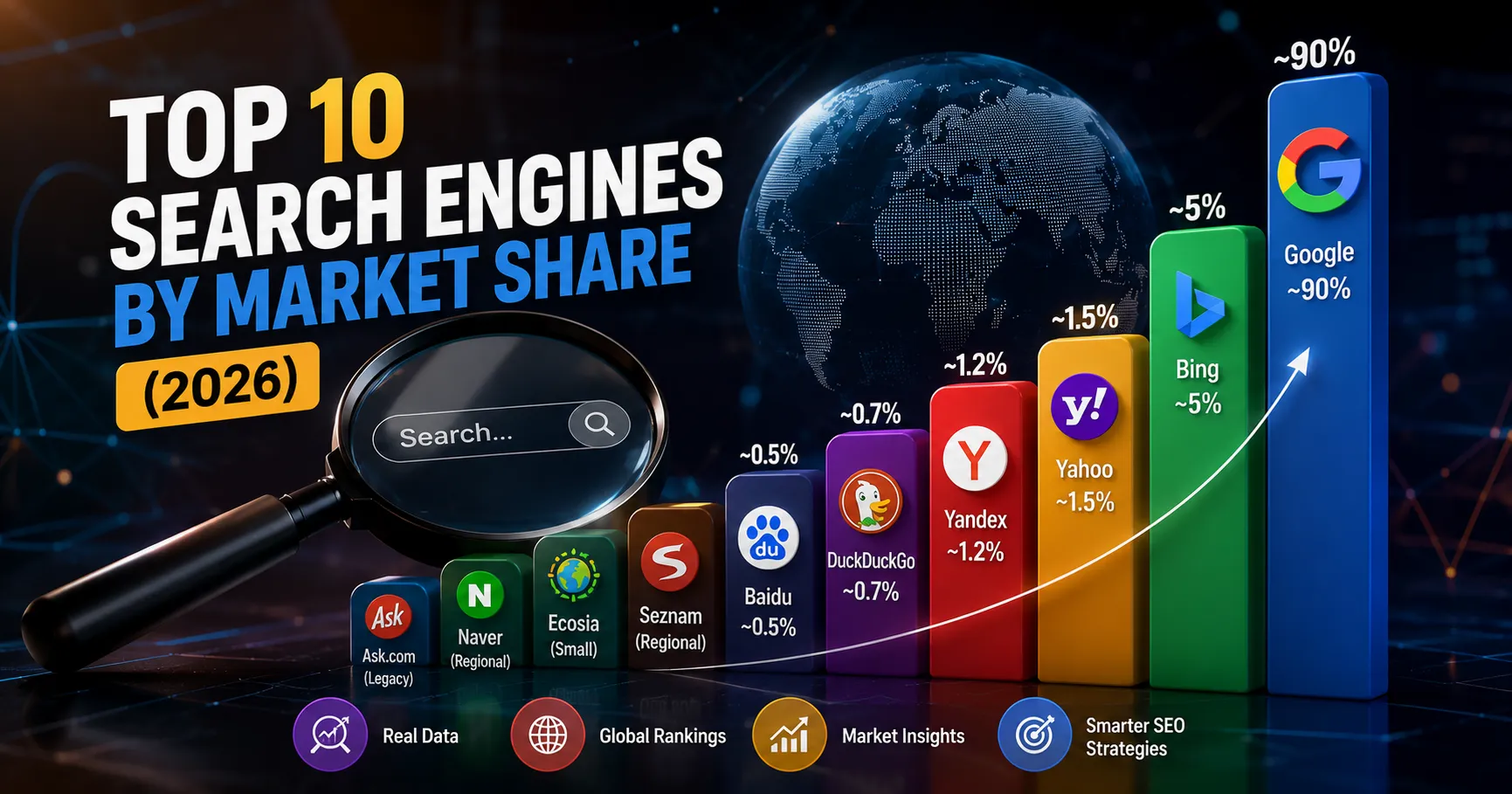
So Google has close to 90% of the world’s search traffic. Most people already know that number, or something close to it, but almost nobody stops to ask what’s happening in the leftover 10%. Turns out a lot is happening there. Real users, real businesses built around Bing or Yandex or Baidu, entire markets where Google isn’t even the main player. Looking at search engines by market share properly, rather than just assuming Google is the whole picture, changes how you think about online visibility.
A friend asked me last week if anyone actually still uses search engines other than Google. I laughed, then realized I didn’t have a great answer ready. So I went and dug through the numbers properly. This is what came out of that.
What Is a Search Engine, Really?
Software that reads the internet and remembers what it reads. That’s really the whole idea. It crawls pages by following links around, stores what it finds, then ranks all of it when someone types a question in.
Doesn’t sound complicated on paper. In practice it’s a mess of signals nobody fully agrees on. But if your pages aren’t even getting crawled in the first place, none of that complexity matters anyway. Nothing else works until that basic step happens.
Search Engine vs Browser
Two different things, constantly confused. Browser is the app, Chrome, Safari, Edge, whatever you’re reading this on right now. A search engine is what you actually use inside that app to look something up.
You could open Chrome and still search with Bing. Nobody’s stopping you. Which is exactly why browser market share numbers and search engine numbers rarely match up, even though people assume they will.
Top 10 Search Engines by Market Share (Table)
| Rank | Search Engine | Approx. Market Share | Known For |
| 1 | ~90% | • Fastest, most relevant results • Deep Android and Chrome integration • Best-in-class Maps, Images, YouTube search | |
| 2 | Bing | ~5% | • Default on Windows and Edge • Tied closely to Copilot AI search • Popular with enterprise users |
| 3 | Yahoo | ~1.5% | • Long-time homepage habit for many • Strong news, finance and email hub • Runs on partnered search tech |
| 4 | Yandex | ~1.2% | • Dominant across Russia and CIS • Deep local language understanding • Trusted despite small global share |
| 5 | DuckDuckGo | ~0.7% | • Zero tracking, privacy-first • Loyal, steadily growing base • Clean, ad-light results |
| 6 | Baidu | ~0.5% | • The default engine inside China • Massive local trust • Essential for China-facing brands |
| 7 | Naver | Regional | • Blends search, news and shopping • South Korea’s go-to platform • Feels more like a lifestyle hub |
| 8 | Ecosia | Small | • Ad revenue funds tree planting • Appeals to eco-conscious users • Competes on values, not scale |
| 9 | Seznam | Regional | • Czech Republic’s local favorite • Strong cultural relevance • Holds ground against Google locally |
| 10 | Ask.com | Legacy | • Built around direct Q&A search • Mostly nostalgia and brand recall • Minor player today |
These shift around a bit depending on who’s measuring and when. Close enough for the bigger picture though.
1. Google
Google barely needs an introduction at this point, does it. What’s actually interesting is how it stays on top. Not one single trick. Android ships with it. Chrome’s address bar is basically a Google search box in disguise. YouTube, Maps, Gmail, all of it loops back around eventually. Half the time you don’t even choose Google. You just end up there because everything nearby was built to lead you back to it.
2. Bing
People love to write off Bing, until you point out that “just 5%” of a number as huge as global search still adds up to a genuinely massive user base. It’s not out here trying to beat Google, that’s not the game. It sits comfortably on Windows and Edge, scoops up everyone who never bothered changing default settings, and now it’s leaning hard into Copilot. Small piece of a huge pie is still a lot of pie.
3. Yahoo
Feels weird saying this, but Yahoo survives almost entirely on nostalgia now. People who signed up in 2004 are still logging in, still checking that homepage out of pure habit, barely thinking about it. The search results running behind the scenes aren’t even fully Yahoo’s own tech these days. Doesn’t seem to matter much though. Habit is stubborn like that.
4. Yandex
Here’s a fun one. Yandex sits at barely 1% globally, practically invisible on a world map of search. Then you look at Russia specifically and suddenly it’s the dominant name there, not Google. Global numbers can hide entire markets if you’re not paying attention to where the traffic is actually coming from.
5. DuckDuckGo
One sentence sums up DuckDuckGo completely: we don’t track you. That’s the whole pitch, nothing fancier than that. It’s never going to out-scale Google, and honestly it doesn’t seem to want to. Privacy just keeps mattering more to more people every year, and this engine quietly benefits from that shift.
6. Baidu
Step outside China and Baidu is basically a footnote. Step inside and it’s everything, the default option, the name people trust without thinking twice, the platform every local business builds around first. Ignore Baidu because its global percentage looks small, and you’ve basically written off an entire market.
7. Naver
Naver stopped feeling like a normal search engine to me the moment I actually used it properly. It’s more of a portal, search mixed together with news, shopping, blogs, community boards. South Korea runs on this thing. Google’s technically there too, sure, but it’s playing a distant second in a country Naver already owns.
8. Ecosia
Tiny global share, but Ecosia isn’t even trying to win the numbers game. Every search funds tree planting through ad revenue, that’s the entire hook. Nothing to do with search quality or speed at all. For people who care about that kind of thing, and there are more of them than you’d expect, that reason alone is enough to switch.
9. Seznam
What keeps Seznam alive in the Czech Republic has nothing to do with beating Google technically. It just knows the local language and culture better, plain and simple. That’s basically the story behind most local search engines that manage to survive, they know their own backyard better than any global giant ever will.
10. Ask.com
Remember the whole “ask a question, get a direct answer” branding Ask.com used to run with? It’s been a long time. It’s not pulling meaningful traffic anymore, not really, but the name keeps showing up on lists like this one anyway. Pure brand memory at this point, nothing more.
Why Google Keeps Winning
Not really about having the smartest algorithm anymore, if that was ever the full story. A handful of things stack on top of each other here.
Android reaches into nearly every corner of the mobile world. Chrome is already being open on most people’s screens. Default search deals quietly baked into devices before anyone even sets them up. Years of indexing infrastructure that’s genuinely hard to replicate. Ecosystem pull from Maps and YouTube and local search results. And just plain habit, two decades deep of people saying “just Google it” without thinking twice.
None of that makes everyone else pointless though. Bing, Yandex, Baidu, Naver, they’re all still carrying real weight depending on who you’re actually trying to reach.
How AI Is Quietly Reshaping Search
Something’s shifting right now, worth paying attention to. More people are just asking AI tools directly instead of scrolling through a page of results. Traffic into those AI assistants keeps climbing steadily, but the traffic flowing back out to actual websites isn’t keeping pace with it. Kind of an uncomfortable gap when you sit with it for a second.
Practically speaking, getting “found” isn’t only about ranking anymore. Content needs to be clear enough that an AI system can read it and summarize it without mangling the point. A few things genuinely help with that. Answer the real question early, don’t bury it. Use headings that actually make logical sense, not just ones that look nice. Back claims up with real sources. Keep numbers current, stale stats do more damage than people realize. Tables and FAQs help too, when they’re actually useful and not just there for show.
What This Means If You Run a Website
Google’s still priority number one for most sites, no real argument there, it controls the biggest chunk of traffic by a wide margin. But putting everything into one basket has never been a smart long-term bet, and that’s more true now than it used to be.
Bing deserves more attention than most people give it, particularly anywhere Microsoft’s ecosystem shows up. Regional engines, Baidu, Yandex, Naver, Seznam, can completely outweigh Google depending on the country you’re targeting. Privacy-focused DuckDuckGo users are a small slice but a growing one. AI answer engines are already summarizing content before anyone clicks through to read the source. And the boring technical basics, crawlability, page speed, structured data, still quietly decide most of the outcome underneath all of this.
Quick Checklist for Better Search Visibility
- Check pages are actually crawlable. No stray noindex tags or blocked robots.txt rules hiding somewhere unexpected.
- One clear H1 per page, everything else organized sensibly under H2s and H3s.
- Write for what people are genuinely trying to find, not just a keyword you’re chasing.
- Keep numbers and stats current, especially on anything data-heavy like this.
- Build real trust signals, author details, sources, visible update dates.
- Link related pages together so both readers and crawlers understand how things connect.
- Structure content so AI systems can parse it too, direct answers and tables go a long way here.
Frequently Asked Questions
What is the most popular search engine in the world?
Google, not even close. Roughly 90% of global search traffic runs through it.
What’s the second-biggest search engine globally?
Bing, sitting around 5% worldwide, mostly off the back of Windows and Edge.
Does Bing still matter for SEO?
More than people usually credit it for. Desktop users, Edge, Windows search, and its expanding AI features all keep it relevant.
Is DuckDuckGo actually growing?
Slowly, yes. Global share is still small, but the privacy-focused crowd keeps expanding year over year.
Why does Baidu matter if its global number looks so small?
Because that number hides the fact that inside China, Baidu basically functions as the local Google. Regional context beats the worldwide chart here.
Is AI search going to replace regular search engines?
Not entirely, not anytime soon anyway. AI tools are changing how people look things up, but traditional search engines still carry most of the actual traffic. Safer bet is optimizing for both.